Loyalty Programs Are Undergoing a Major Transformation
For decades, loyalty marketing followed a predictable formula:
Spend money → earn points → redeem reward.
This model worked in the past because customers had limited choices and fewer interactions with brands. Today the situation is completely different.
Customers:
-
interact with brands daily
-
switch providers easily
-
compare prices instantly
-
expect personalization
As a result, traditional loyalty programs are losing impact.
Points and discounts alone no longer create loyalty.
They create temporary incentives.
True loyalty now depends on continuous engagement.
From Transactional Rewards to Relationship Marketing
Classic loyalty programs reward transactions.
Modern loyalty programs reward relationships.
Customers do not remain loyal because they saved €2 on a purchase.
They remain loyal because they feel recognized and understood.
The shift is fundamental:
Old loyalty: “Buy more to earn.”
New loyalty: “Engage more to belong.”
Brands are moving from purchase-based loyalty to interaction-based loyalty.
The Rise of Conversational Loyalty
One of the biggest changes shaping the future of loyalty is communication.
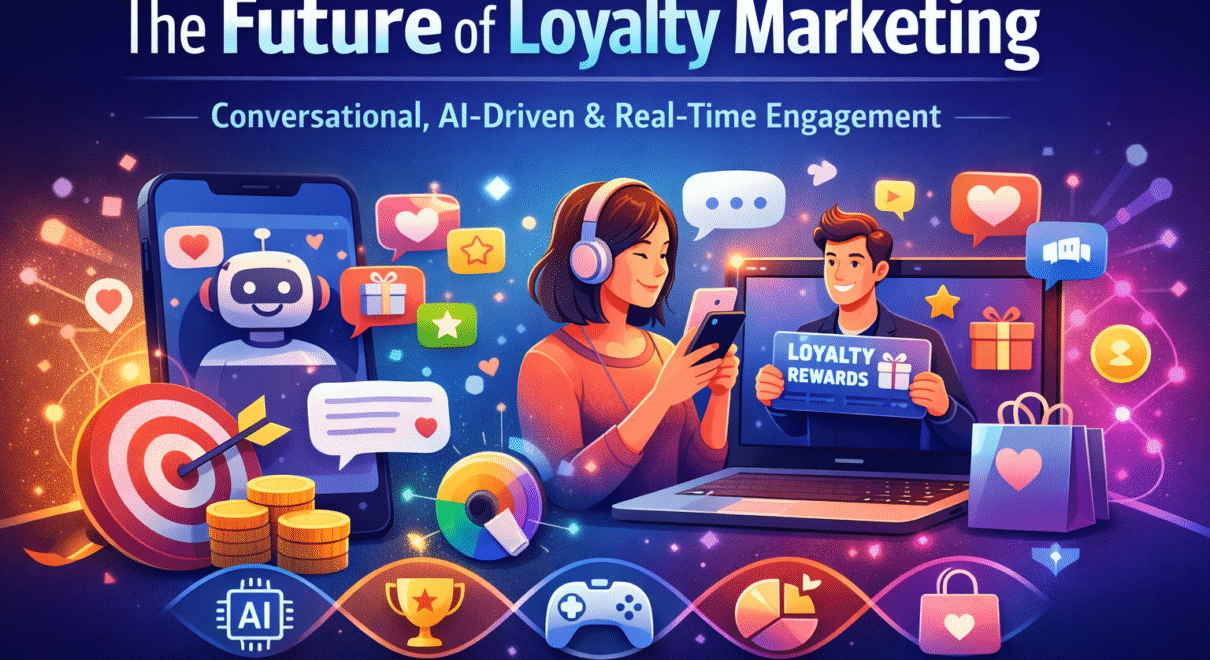
Customers increasingly prefer messaging over websites or apps. Businesses now interact with customers through:
-
WhatsApp
-
Viber
-
Messenger
-
SMS
-
voice assistants
Conversational loyalty allows brands to engage customers directly through these channels.
Every interaction becomes a loyalty opportunity:
-
checking points
-
receiving reminders
-
redeeming rewards
-
personalized suggestions
Rewards are no longer static.
They respond to behavior in real time.
A loyalty program becomes an ongoing dialogue instead of a periodic promotion.
AI-Driven Personalization
Artificial intelligence enables loyalty programs to adapt automatically.
Instead of offering the same promotion to everyone, the system analyzes:
-
purchase frequency
-
visit patterns
-
preferred products
-
engagement history
Then it delivers personalized rewards.
Examples:
-
a café customer receives a morning offer
-
a retail shopper receives a product recommendation
-
a gym member receives motivation after inactivity
Personalization increases relevance, and relevance increases retention.
Emerging Trends Shaping Loyalty Programs
Hyper-Personalized Rewards
AI creates individualized offers instead of mass campaigns.
Gamified Engagement
Challenges, missions, and achievements encourage repeat behavior.
Emotional Loyalty
Two-way communication builds connection beyond discounts.
Micro-Rewards
Small, timely incentives are more effective than large delayed rewards.
Omnichannel Journeys
Customers earn and redeem rewards seamlessly across online and physical environments.
Real-Time Engagement
Traditional loyalty operates periodically.
Future loyalty operates continuously.
Modern systems trigger engagement based on live behavior:
-
abandoned visits
-
upcoming purchases
-
reward proximity
-
inactivity
This timing matters more than the reward value.
A small reward at the right moment is more powerful than a large reward at the wrong moment.
Cross-Industry Adoption
Multiple industries are already adopting modern loyalty strategies.
Retail
Personalized recommendations and behavioral incentives.
E-commerce
Cart-based engagement and dynamic rewards.
Hospitality
Experience-based benefits and guest recognition.
Fintech
Usage-based benefits and engagement rewards.
All share a common goal: long-term customer relationships instead of one-time transactions.
Loyalty as a Retention Strategy
Marketing budgets traditionally focused on acquisition.
But acquiring customers is increasingly expensive.
Retention has become more valuable.
A modern loyalty platform is no longer just a promotion system.
It is a retention infrastructure.
Businesses use loyalty not to attract customers —
but to keep them.
Beyond Points and Discounts
Points and discounts will not disappear.
They simply become secondary.
The primary value of a loyalty program is engagement.
Customers stay loyal when they feel:
-
recognized
-
assisted
-
remembered
-
understood
Technology now allows businesses to deliver this experience at scale.
Final Thought
Loyalty is no longer a card, an app, or a coupon system.
It is a continuous relationship powered by communication, data, and timing.
The brands that succeed in the next decade will not be those offering the biggest discounts.
They will be those creating the strongest connections.
Loyalty is no longer a program.
It is a conversation.